Mitsuhoshi | Shopify full-order build case study for a mail-order food EC
 1mm 開発部


- Industry
- Food and drink
- Request Type
- Renewal
- Build Type
- Full Order
- Estimated Cost
- Approx. ¥1,500,000
Mitsuhoshi, a curated food delivery brand with the concept "delivering exceptional flavors." The sourcing-based business model creates risk around inventory and quality control that makes it difficult to simply expand the product range — and with fewer product pages, entry points from search engines are naturally limited.
This challenge was solved through a content strategy. Building up hands-on review articles using Amazon Associates and affiliate content through A8 created content volume without holding inventory. A "region × product" keyword strategy — targeting searches like "mail-order gourmet in [prefecture]" and "home delivery food in [city]" across all 47 prefectures — expanded the footprint of search-driven traffic.
By focusing on low-competition keywords, the site now holds stable search rankings. New customers acquired through marketplaces are guided to the dedicated site for subsequent purchases to capture the margin difference — creating a three-channel revenue model combining affiliate income, direct retail, and marketplace sales.
Solving the content shortage that comes with limited owned products
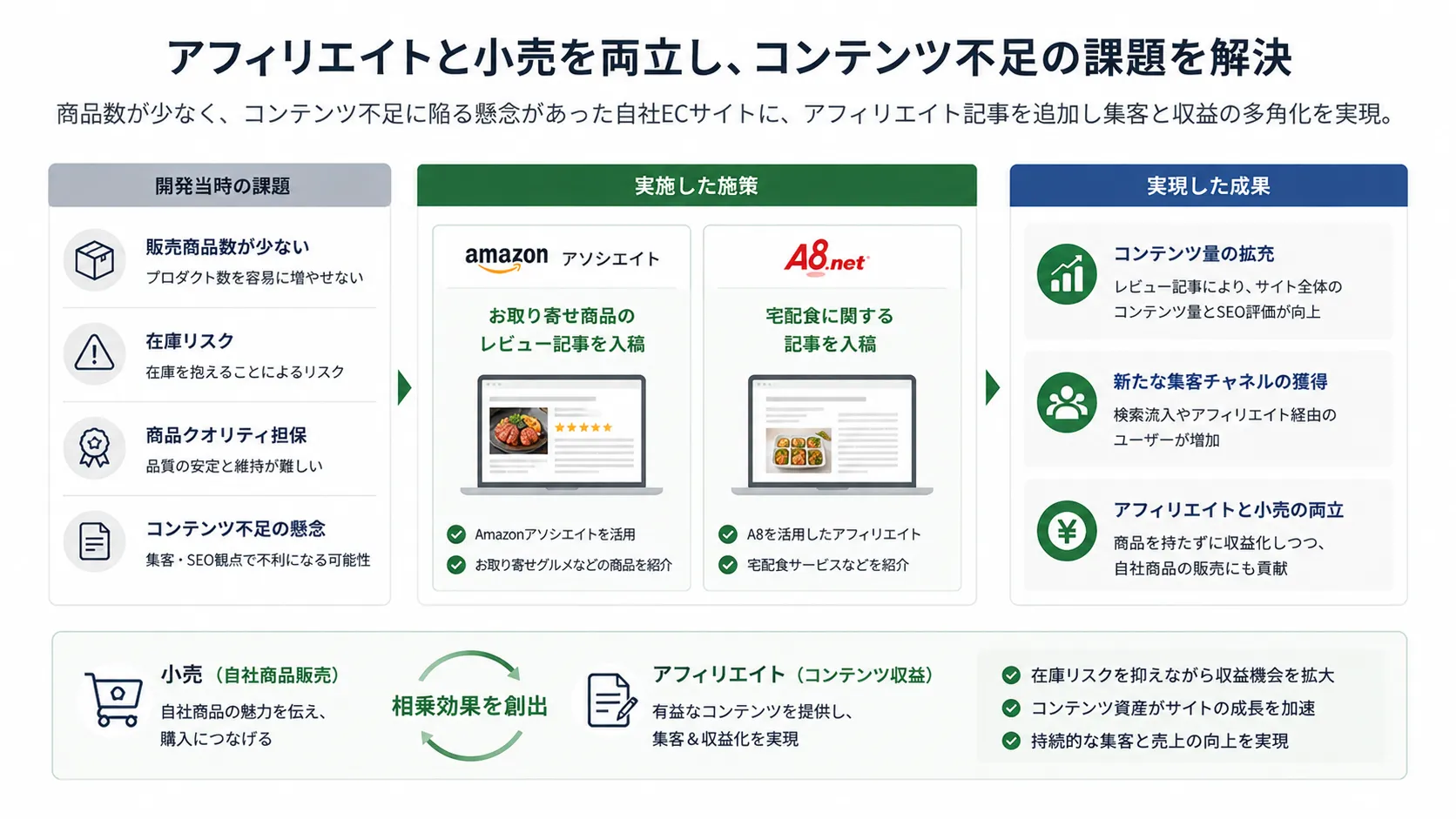
Fewer product pages means fewer entry points from search engines. But expanding into products that are hard to quality-control risks the brand's credibility.
To resolve this tension, we combined review articles for mail-order products using Amazon Associates with affiliate content introducing home delivery food services through A8.
This approach builds content volume without holding inventory, enabling both affiliate revenue and direct Shopify retail.
From product reviews to a "region × product" strategy
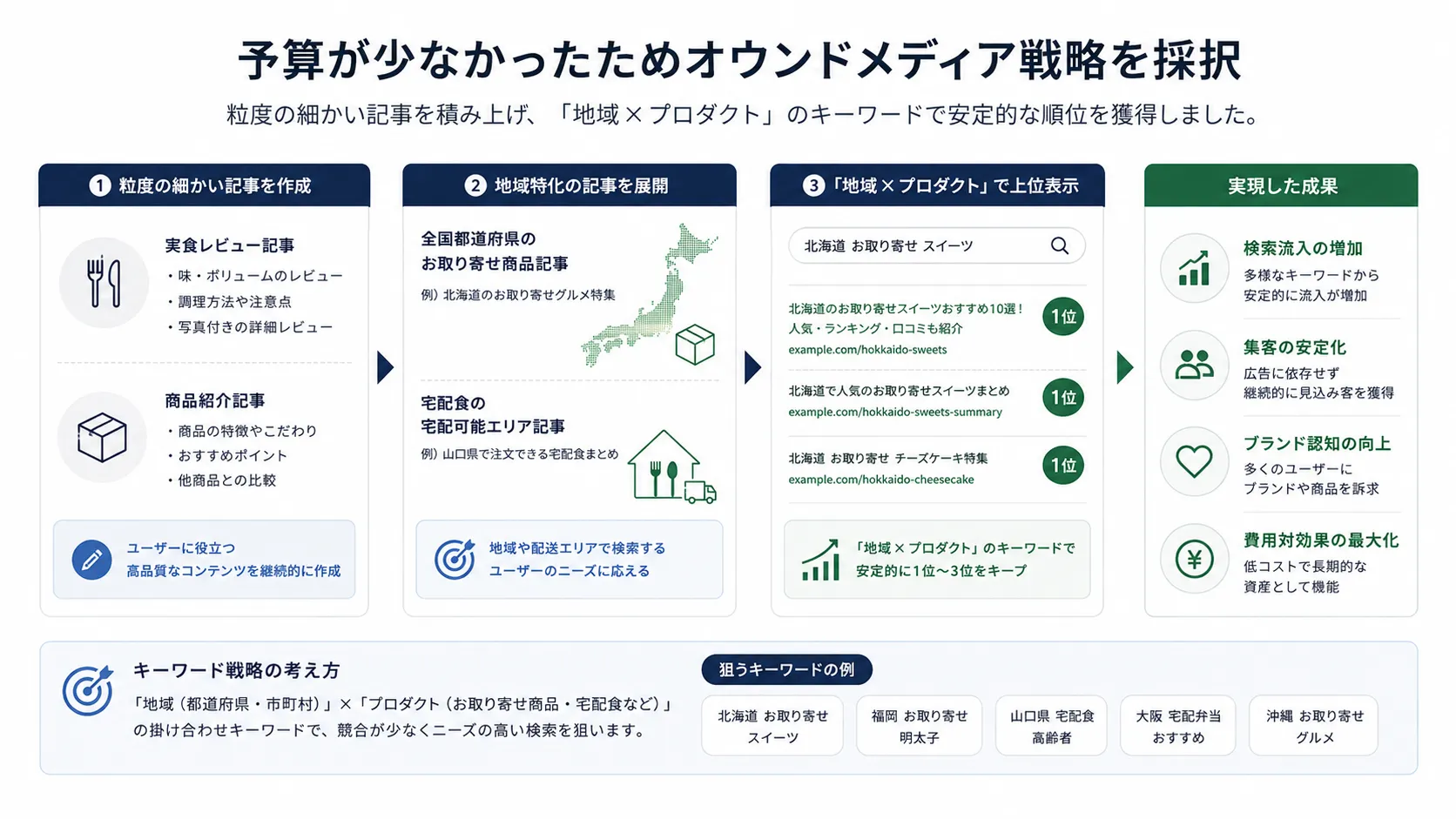
The content strategy was designed in two stages.
Building a "trusted site" foundation with hands-on reviews
In the first stage, we built up detailed product review articles and product introductions. Content that covers a specific product or delivery service in depth ranks well for pre-purchase searches like "product name + reviews" and "product name + impressions," driving the first wave of traffic to the site.
By sharing product characteristics and real tasting impressions through articles, readers can move naturally from the article into the site's purchase pages.
Expanding search traffic with "region × product" keywords
Once the review content established the foundation, we expanded into content targeting keywords that combine a region with a product category — "mail-order gourmet in [prefecture]," "home delivery food in [city]."
Designed for all 47 prefectures, this creates many pages that directly answer the common question "Can you deliver to my area?"
Region × product keyword combinations tend to have low competition, and the site now holds stable search rankings across them.
Combining marketplaces and the dedicated site to maximize margins
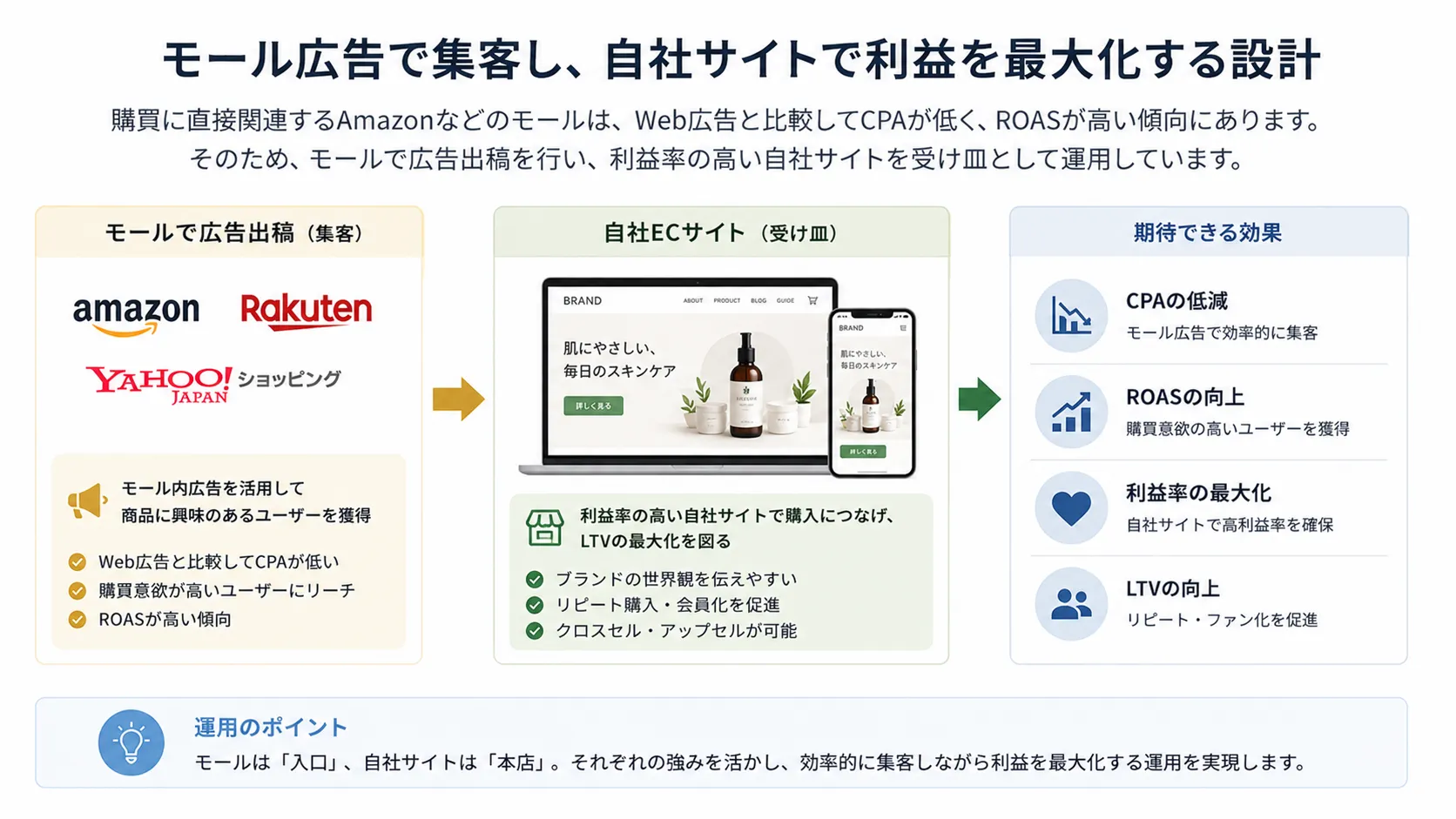
Acquiring new customers through the marketplace
Marketplaces like Amazon tend to deliver lower CPA and higher ROAS compared to web advertising. By listing and advertising on platforms where purchase intent is already high, you can efficiently build product awareness and capture first purchases.
Improving margins through the dedicated site
Marketplace fees reduce margins, so the same product earns less per sale than through the dedicated site. By guiding customers who first discover a product on a marketplace back to the dedicated site for their next purchase, the margin difference can be captured.
Follow-up emails to buyers and exclusive incentives on the dedicated site create the flow to make this happen.
1mm 開発部
1mm's Shopify development group. Drawing on hands-on experience building and renewing e-commerce sites with Shopify (Liquid), the team publishes practical information on costs, work cases, and operational know-how. All articles are produced under the supervision of the technical lead.
1mm 真鍋
Specializes in building e-commerce sites with Shopify (Liquid), with hands-on development experience spanning Next.js, React, and TypeScript (this site's stack), Python (Django), WordPress (PHP), and HTML/CSS — across both front end and back end. Draws on this implementation expertise to supervise Shopify development articles and work cases as the technical lead.
FAQ
Yes. In this case, owned products are supplemented with review articles for mail-order products using Amazon Associates and affiliate content introducing home delivery food services through A8. This approach builds content volume without holding inventory, enabling both affiliate revenue and direct retail through Shopify.